
Questions & answers
Questions we are actually asked
Nineteen answers, each one straight out of the program documentation on this site. Where the honest answer is “we cannot tell you that yet,” it says so.
The company
01 / What this is
01
What is Fantom Defense?
Fantom Defense designs autonomous air, sea, land, space and subterranean systems on one planning assumption: the link will be gone. Every node carries the whole mission model — world model, rules-of-engagement gate and mission plan — inside a 40 W envelope, and signs every engagement at the edge. It is the third Fantom company, alongside Fantom Aero and Fantom Robotics.
02
What systems does Fantom Defense build, and in which domains?
Twenty-five systems across five domains, plus the REVENANT autonomy stack and the FORGE-2 plant. Sub-T: CATACOMB, DOWSER, BARROW, WAKE. Sea: LEVIATHAN, STYX, DEADFALL, TIDEWALL. Land: GRIM, GHOST, VIGIL, PALL, CAIRN, KNELL, MARROW, VEIL. Air: WRAITH, POLTERGEIST, BANSHEE, SHADE, REQUIEM. Space: LANTERN, CHARON, SHROUD, BEACON.
03
Has anything Fantom Defense builds flown, or been delivered to a customer?
No. Nothing on this site is in service. WRAITH has not flown; first flight is targeted for Q1 2029. No system has been built, delivered to a customer or deployed, and we are pre-revenue, pre-award and pre-first-article. Every number published here is a design target, not a test result.
Denied environments
02 / When the link is gone
04
Which systems work in EMCON, comms-denied or GPS-denied operations?
All of them. It is the design point, not a mode. WRAITH fights fully in EMCON with zero uplink and treats GPS as an input, never a dependency — navigation is inertial, celestial, terrain-referenced and visual-inertial. REVENANT MESH carries traffic on RF, free-space optical, confined optical, acoustic, magneto-inductive and spooled fibre, so undersea and underground are bearers rather than exceptions.
05
What happens when the network fails?
The system degrades toward itself down four rungs: full mesh, partitioned mesh, local cluster, single node. At every rung the ROE gate still enforces and the signed record still writes. At rung four there are no peers, no uplink and no GPS — the node holds its full world model and executes alone, inside the authority it was handed before it left.
06
Can an autonomous system keep shooting once it is cut off?
Only while a valid authorization token lasts. The node never self-authorizes; there is no rung at which it can. When the last in-scope token expires it keeps flying, keeps sensing and keeps recording — and does not shoot. If WRAITH's token expires in EMCON it disengages and egresses rather than assuming consent.
07
What compute does edge autonomy actually require?
REVENANT CORE runs the whole mission model in 40 W total with a 6.4 GB resident footprint, with profiles down to CORE/L at 3.5 W and CORE/S under a watt duty-cycled. There is no REVENANT server. WRAITH additionally carries 2 × 128 TOPS INT8 sustained at 260 W, plus a 40 W survival node.
Authority and audit
03 / Auditable autonomy
08
How does Fantom Defense meet DoDD 3000.09?
With an artifact rather than a policy. Nine predicates must pass on a deterministic gate running on an isolated processor before force is released: geofence, target class, confidence floor, positive-identification basis, human authorization, deconfliction, collateral estimate, self-state and ledger health. The gate defers by default under uncertainty and cannot be modified by a model update.
09
How is “auditable autonomy” actually implemented?
Ten record types, CBOR-encoded and COSE-signed, each carrying the SHA-384 of its predecessor, signed by a discrete secure element on the node — Ed25519, 60 µs per record, every record, no sampling. Each 180-byte epoch root is gossiped to peers. If the ledger cannot write, the gate cannot permit.
10
Can a third party verify the record?
That is the intent, and it is not finished. revenant-verify runs offline with no network calls and no dependencies, and we have committed to publishing the record schema, the signing scheme, the export format and the verifier as source. The verifier is built and under test. None of it is published yet.
Integration and deployment
04 / Fitting the force
11
Which military network and interoperability standards do these systems speak?
REVENANT LINK is a translation layer into Link 16 (STANAG 5516 J-series via MIDS-JTRS), MADL, TTNT, IBCS, NATO Link 22 (STANAG 5522 NILE), MDL and CoT/TAK. We build the MADL host side, not the waveform, so MADL is an installed option rather than a dependency. JITC interoperability certification is a schedule item, not a research item.
12
Do these systems need a runway, a port or a prepared base?
No. WRAITH launches from a fifty-foot square of CBR 6 ground, level to within three degrees, with no runway at any weight — nineteen minutes from a cold vehicle on a road to wingborne flight with a two-person crew. LEVIATHAN needs a commercial pier and one 30 t crane. VIGIL self-erects in eleven minutes; PALL reaches mission command in eight.
13
Is REVENANT sold separately from the platforms?
No. REVENANT is not an option line. Every Fantom system ships with the profile its power budget can carry, which is what makes cross-domain cueing work — a WRAITH sensor can cue a CAIRN effector because both run the same runtime and the same gate, not because a middleware layer was bolted on afterwards.
Cost, production and procurement
05 / Numbers and process
14
What does an autonomous combat aircraft cost compared with a piloted fighter?
WRAITH's design targets are $21M unit cost at rate and $4,900 per flight hour, against a publicly reported figure near $33,000 per hour for the F-35A. Unique part count is around 2,300, where a crewed fighter of this class is near 11,000. These are design targets, not tested costs, and nothing has been priced under contract.
15
Is an uncrewed system actually cheaper than the crewed equivalent?
Where the site compares directly, yes, and the arithmetic is published. STYX targets $11M unit cost at rate against roughly $15M for a crewed Mk VI patrol boat. CAIRN's layered effector ladder costs $7,982 for forty kills — $200 a kill, a 590× exchange in the defender's favour. Both are design targets.
16
What is the planned manufacturing capacity?
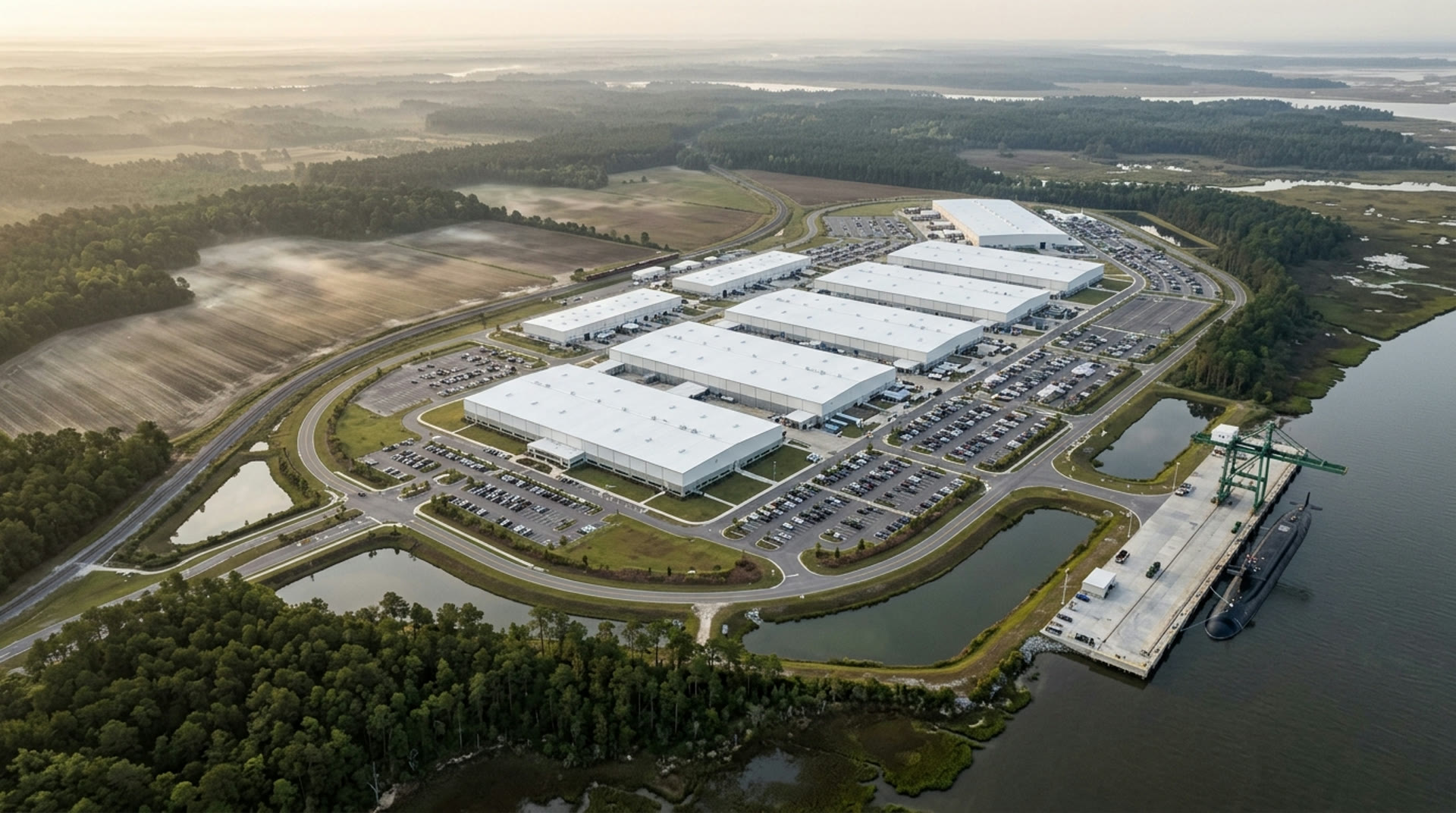
FORGE-2 is a planned 5.4M ft² campus on 1,100 acres under purchase option near Savannah, Georgia, engineered for 4,200 people at full rate in 2032. Planned annual output at that rate includes 300 WRAITH, 4,000 POLTERGEIST, 2,400 BANSHEE, 12,000 SHADE, 12 LEVIATHAN, 48 STYX and 40,000 VEIL. Nothing is built.
17
What are your fleet delivery timelines?
There are none to publish. What exists is a production ramp — first article targeted Q3 2028, full rate in 2032 — and a first article is not a delivery. Delivery follows flight test, and flight test is not our schedule to control. We will not market a first article as a delivery.
18
What are the export-control rules for discussing or buying these systems?
Programs are conducted under ITAR and the EAR. No export-controlled technical data is published on this site, and none is released outside a licence. The customer set is the United States and its treaty allies and designated partners, through Foreign Military Sales and Direct Commercial Sales. No exceptions on the basis of price.
19
How do we start a conversation?
Named desks, not a general inbox: programs@fantom.aero for government program offices and prime teaming, international@fantom.aero for allied ministries, suppliers@fantom.aero for FORGE-2 sourcing, press@fantom.aero, and defense@fantom.aero for everything else. Bring a threat model rather than a demo request.