
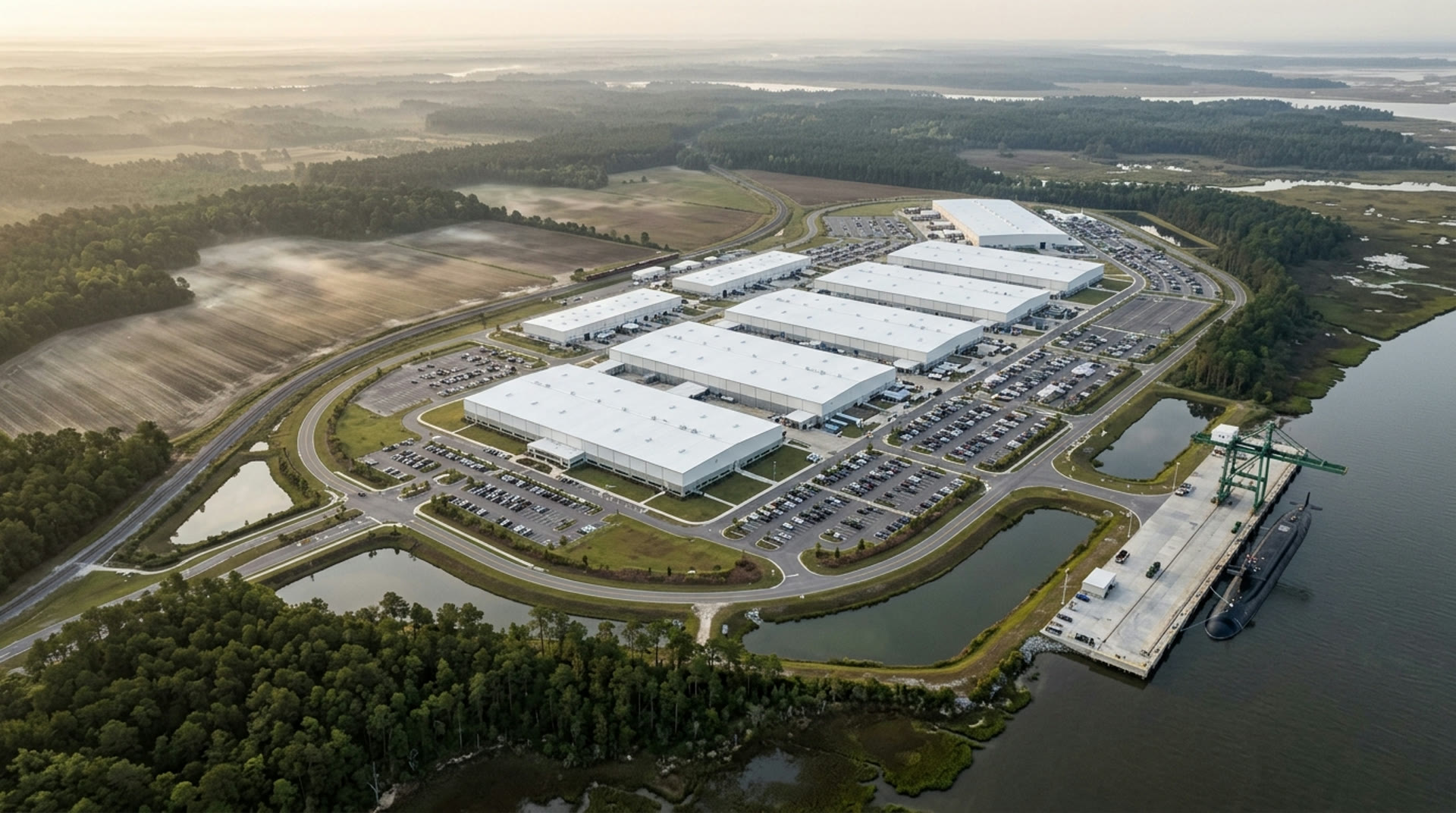
Concept film: Grim climbing a loose rock face in low sun, all four wheeled legs loading in turn while the weapon on its cradle holds level.
Land — Armed autonomous quadruped
It rolls like a vehicle and climbs like an animal
A powered wheel at every ankle, and legs that step over what stops wheels. It sees in the dark and through smoke on its own — and the cradle is mechanically safe until a signed human decision says otherwise.
Mission
Legged robots are patient and slow. Wheeled robots are fast and stop at the first kerb. GRIM refuses the trade.
Four legs, and a powered wheel at the end of each one. On a road, a hardstand or a compacted trail it rolls — quiet, efficient, and quick enough to hold station on a moving patrol without being carried. When the ground stops cooperating, the wheels lock and the legs take over: it steps up a kerb, over a rubble berm, through a breach, down a stairwell, and then it rolls again on the far side. The same machine, two ways of moving, chosen by the machine.
It carries a Q Honey Badger SBR in .300 BLK on a low two-axis stabilised cradle set over the spine, so the weapon's mass sits inside the footprint of the machine rather than out on a mast. The magazine hangs down between the shoulders and the suppressor runs forward over the sensor head. The cradle holds the weapon level while the body pitches and rolls underneath it — the same gimbal that steadies the cameras.
GRIM is not an autonomous shooter. The cradle is mechanically safe until a LEDGER-signed human authorisation verifies against the node's own key. An armed ground robot is precisely where a binding auditability requirement earns its keep — the signed record is what makes the system fieldable, not a feature bolted on afterwards.
Key figures
Every figure above is a design target. None has been measured — no GRIM has been built.
Concept film
Where wheels stop
Concept film · 0:38 · starts muted — unmute for sound
Nothing here is a record of a test. No GRIM has been built, no weapon has been integrated, and nothing has been fired — the machine, the range and the engagement are concept renders made to communicate design intent.
The machine
Every angle
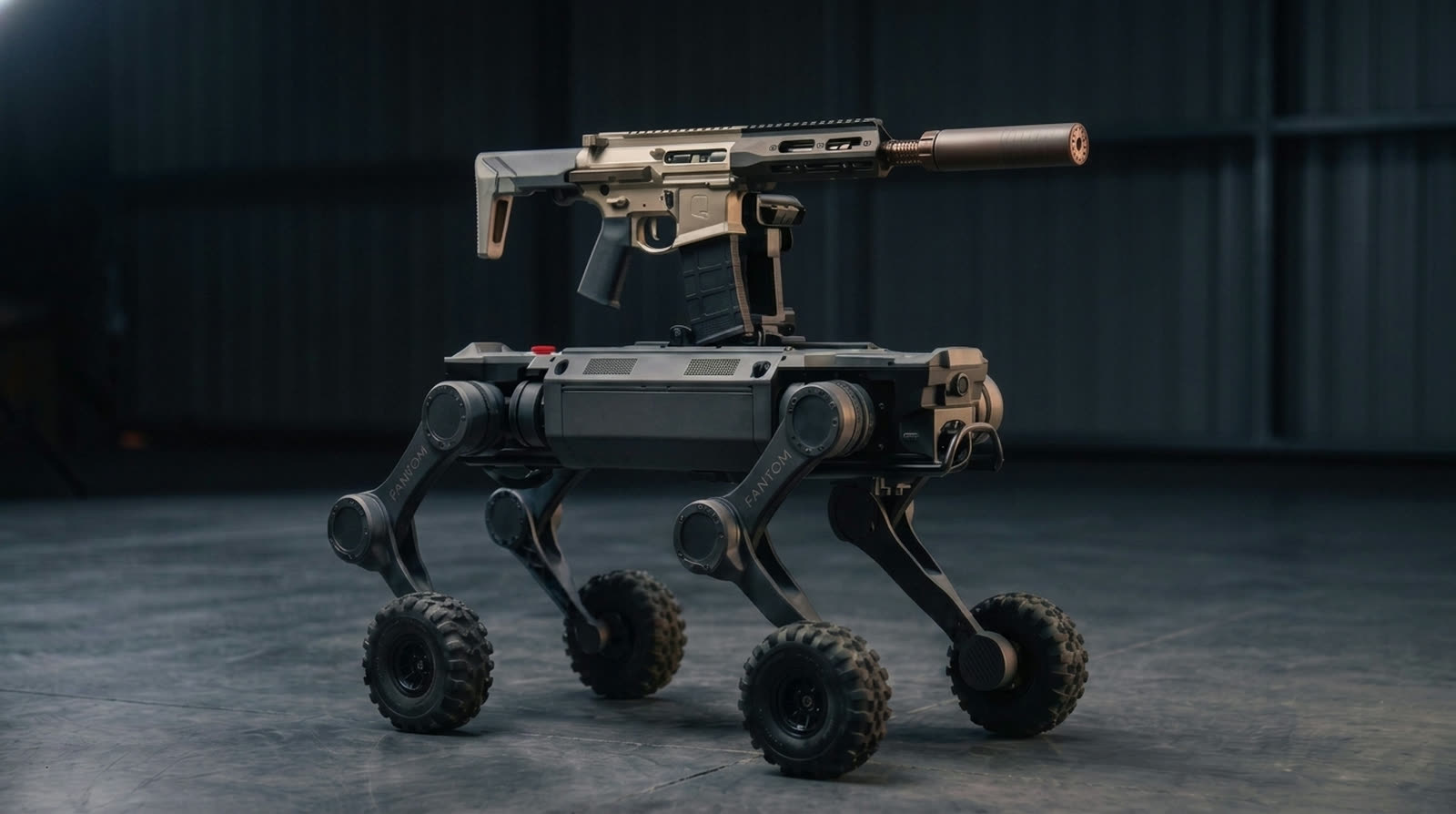
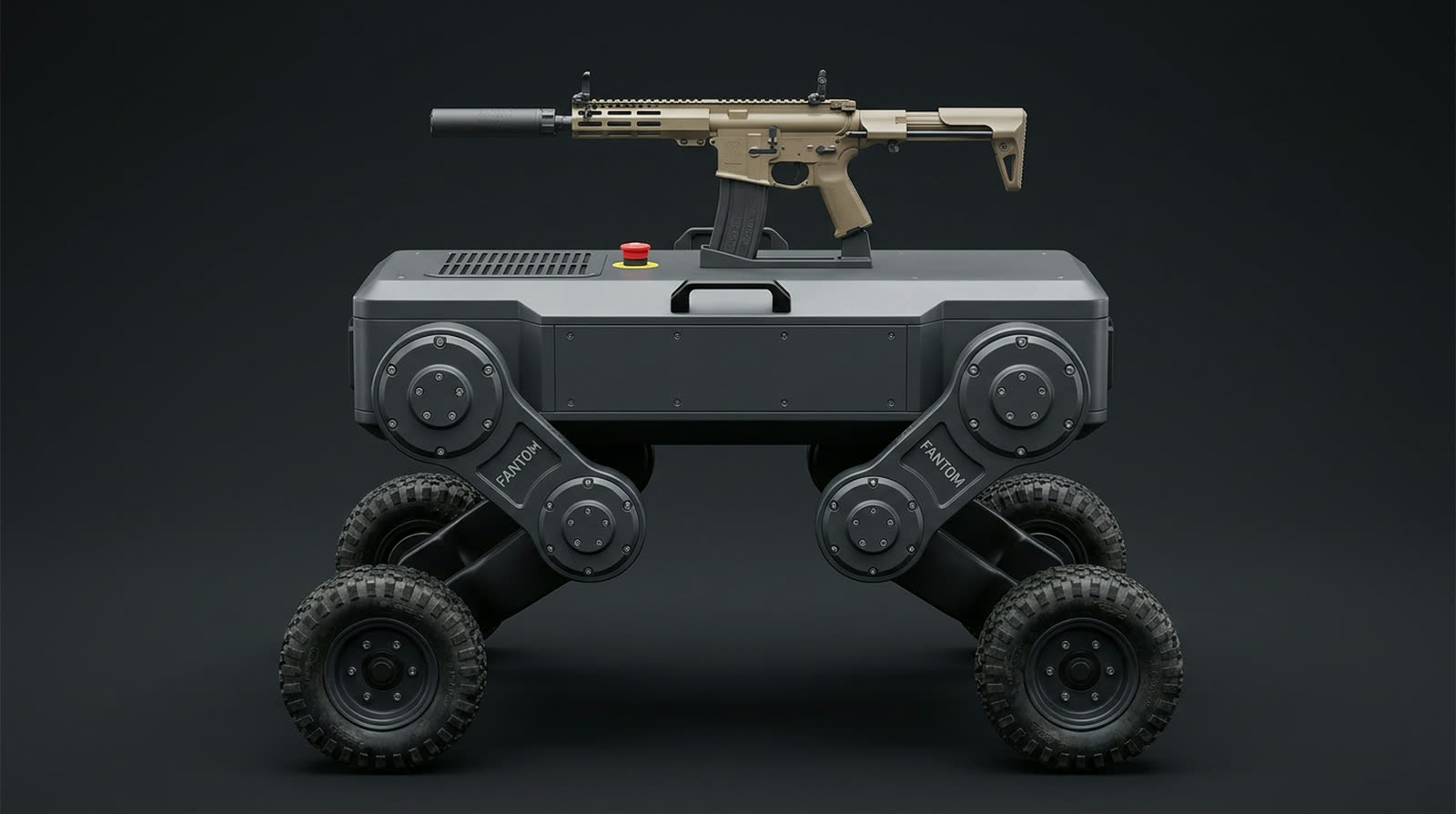
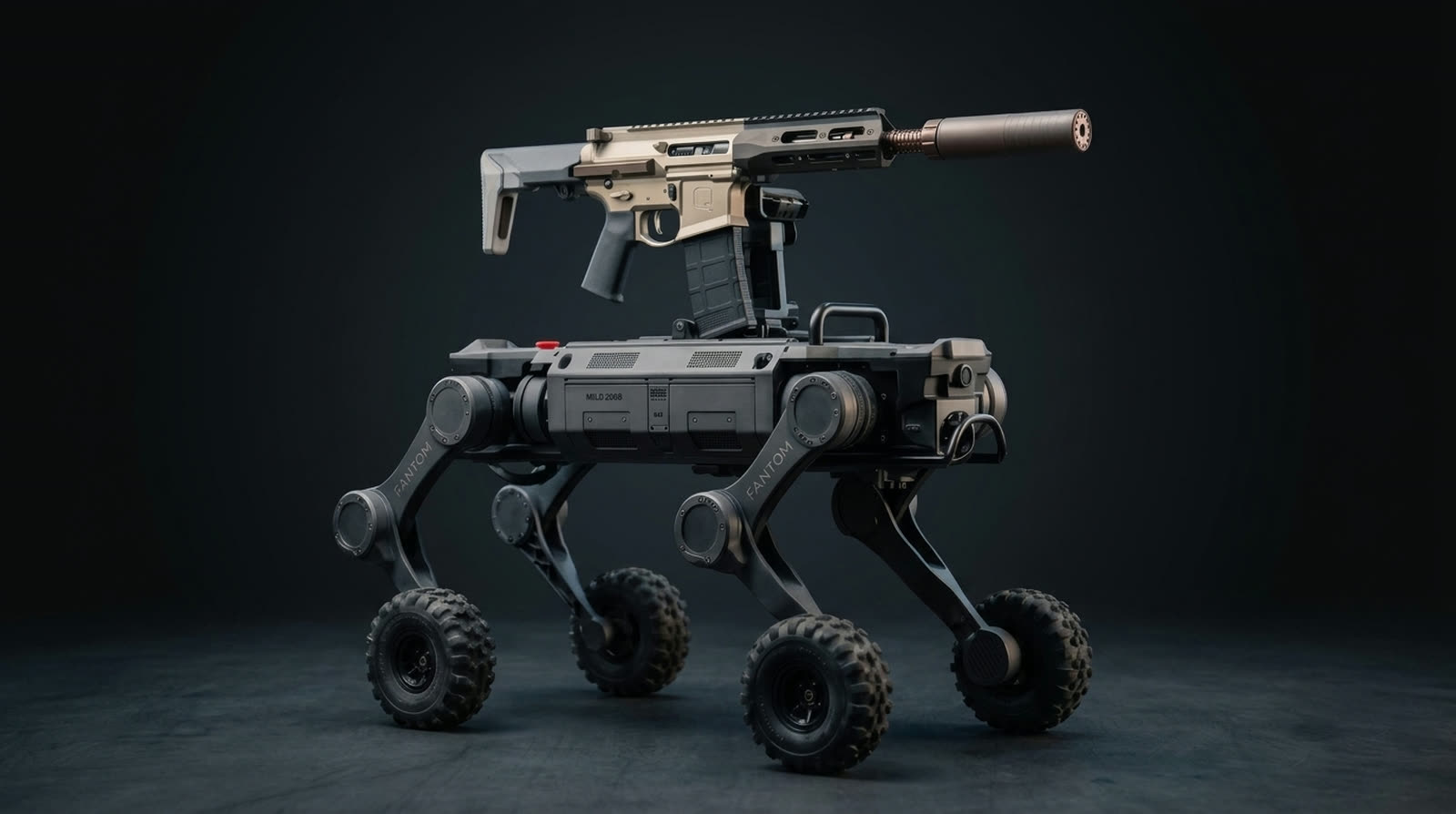
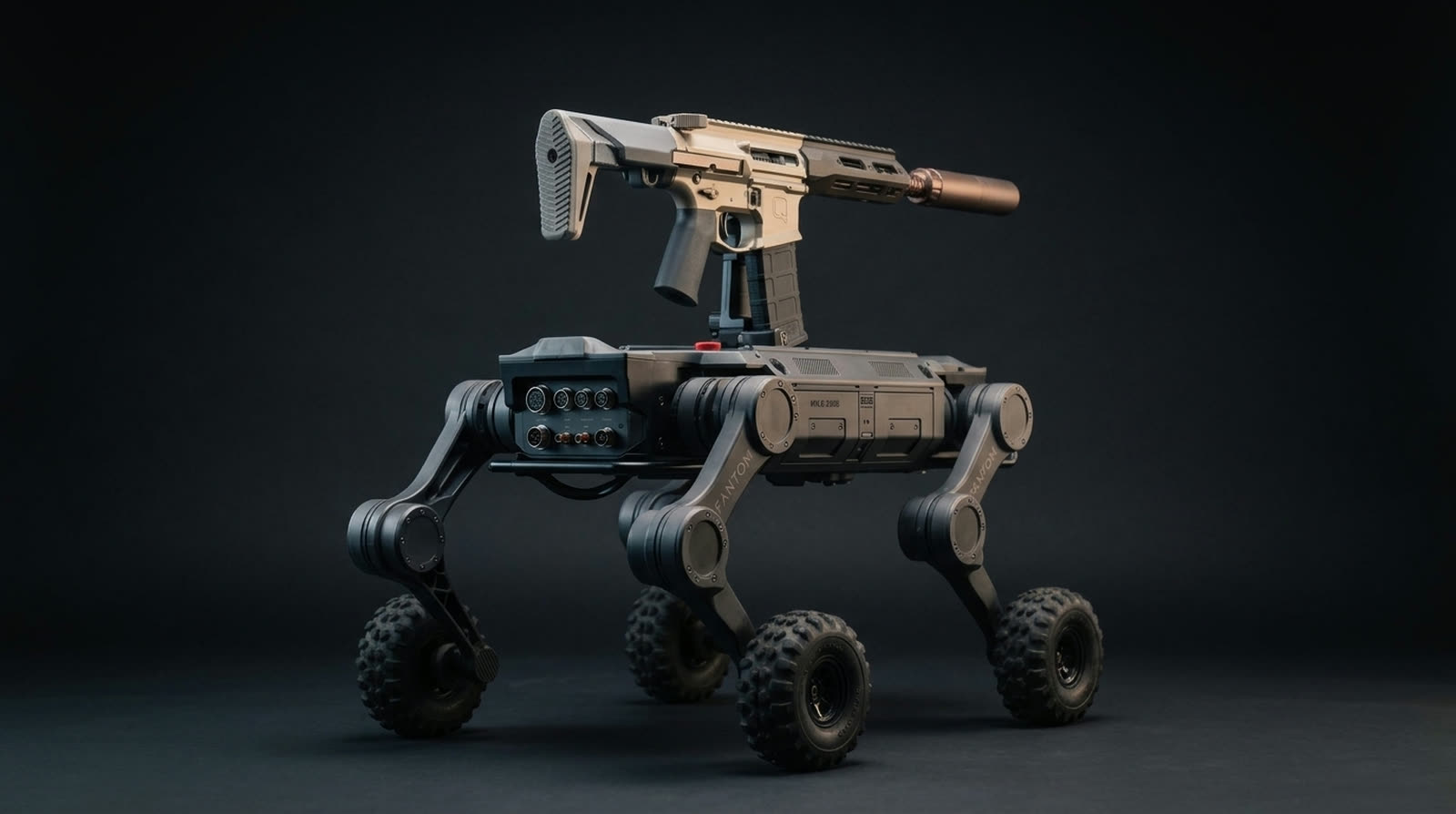
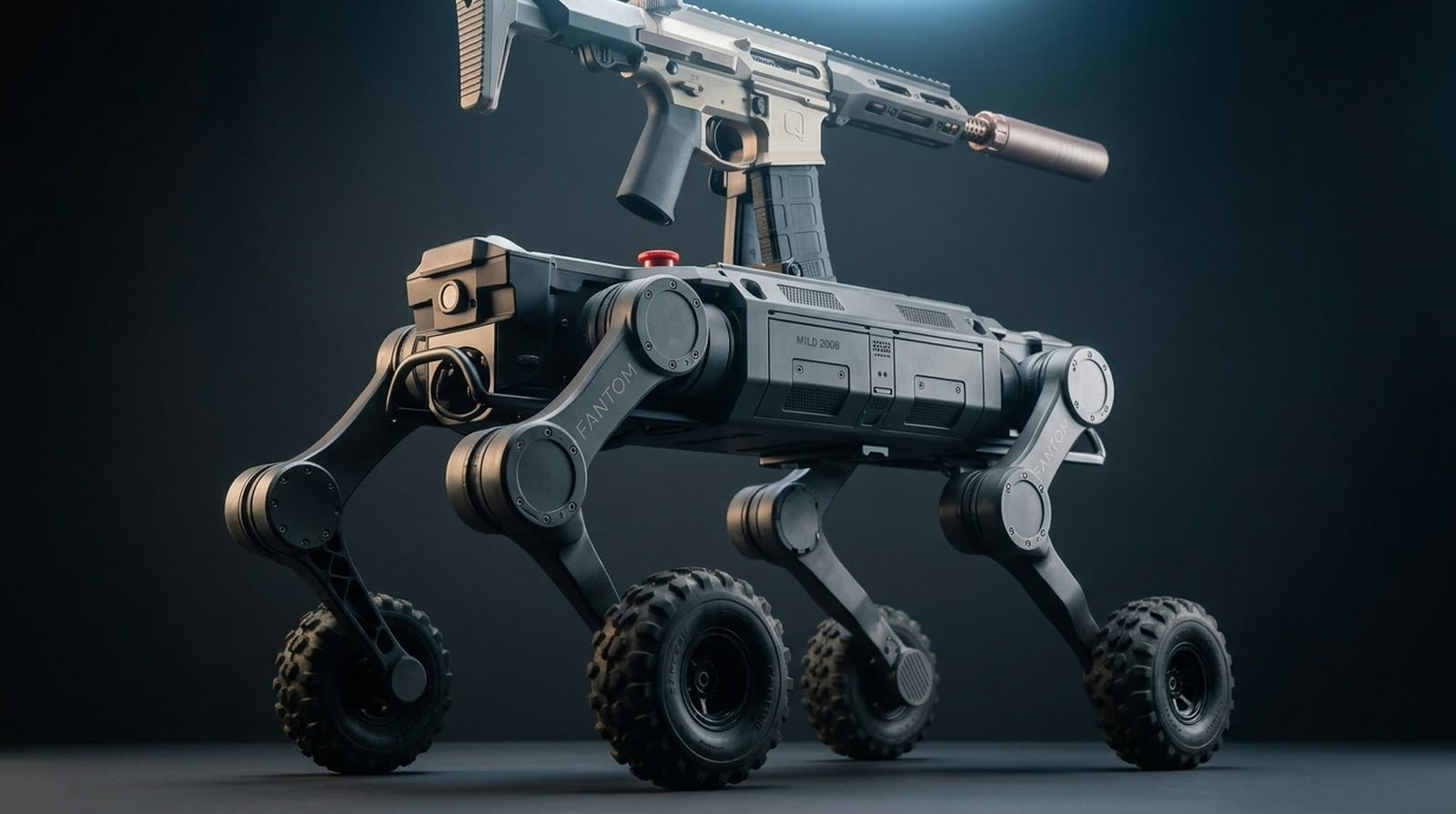
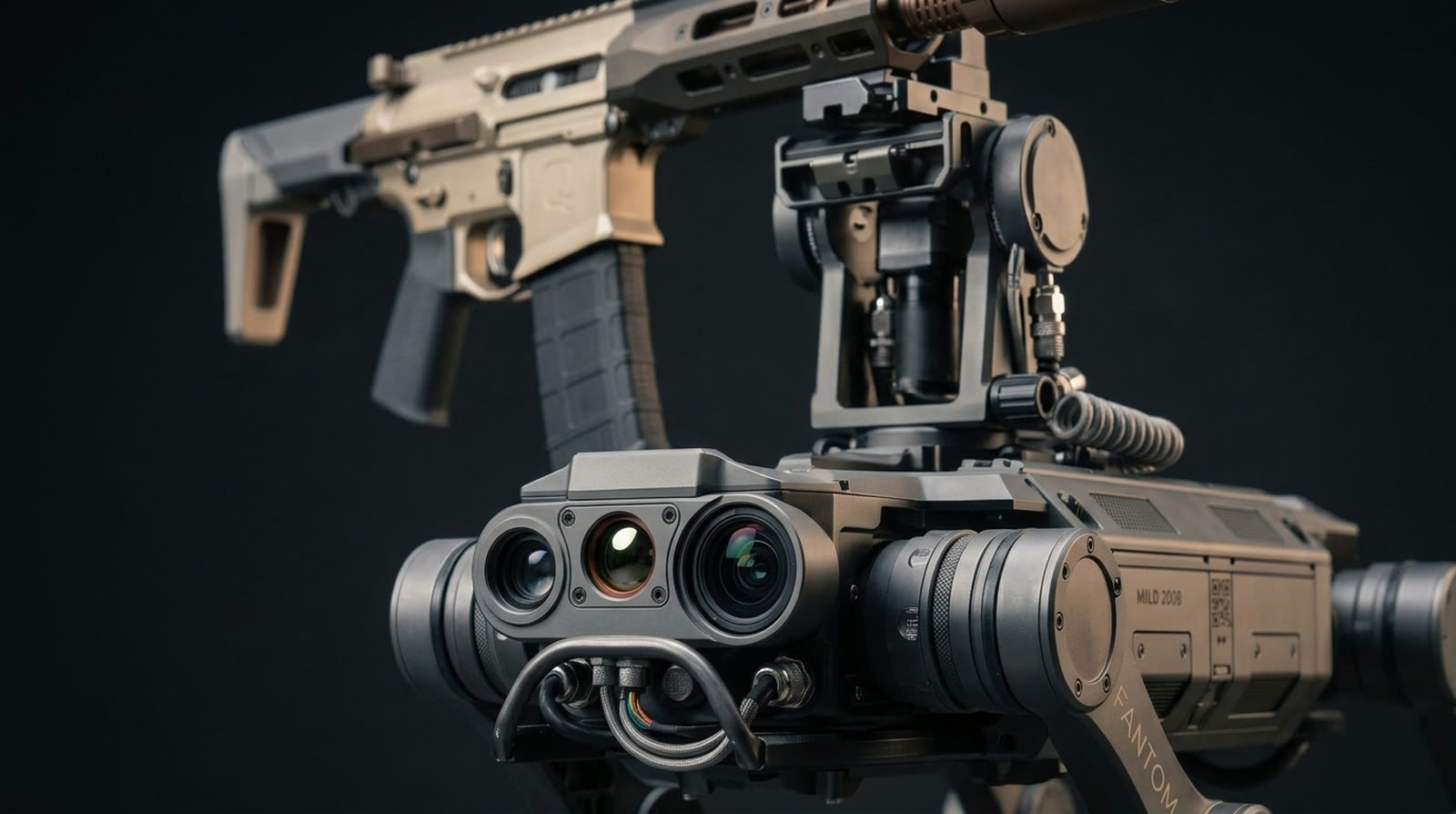
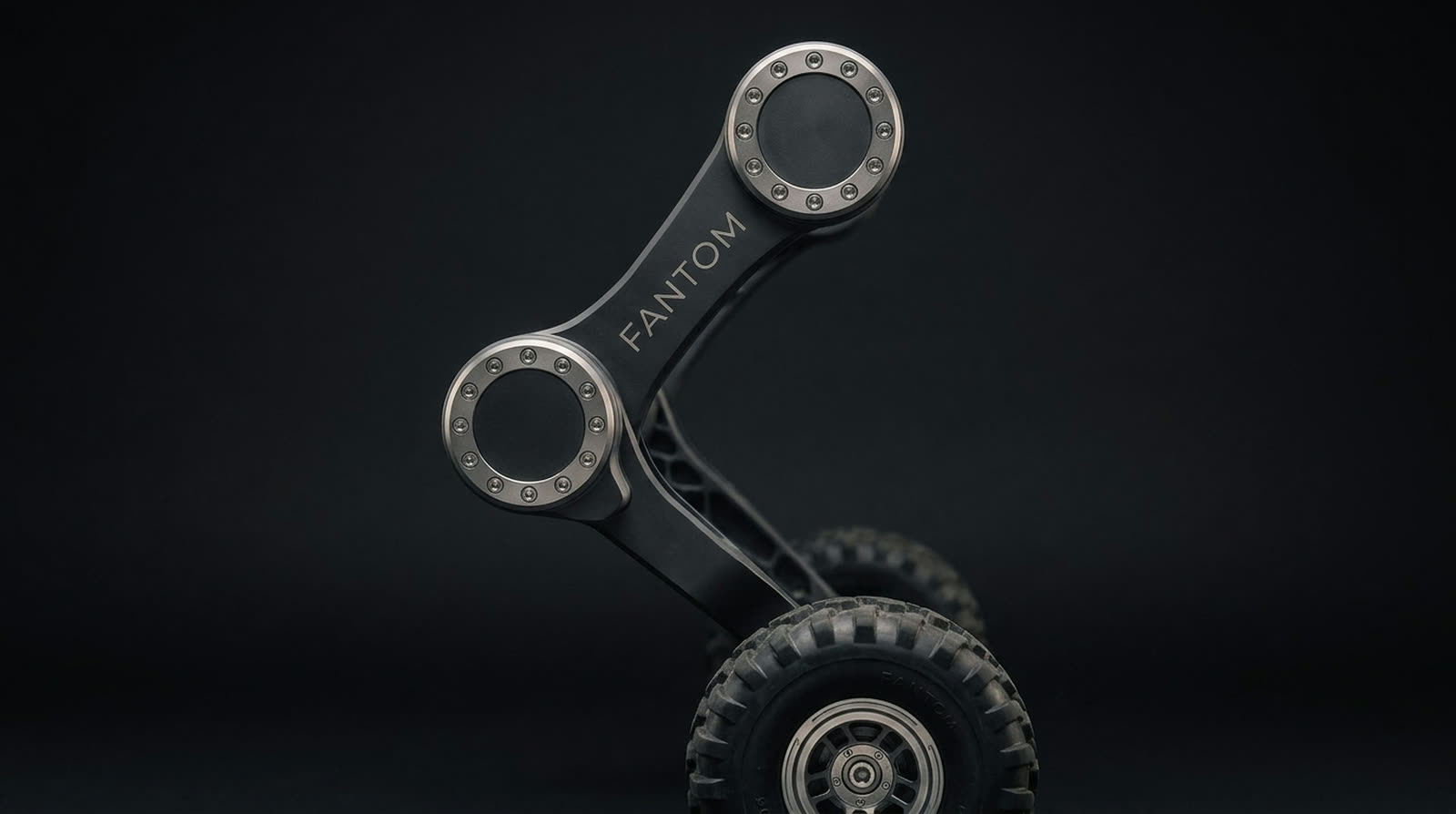
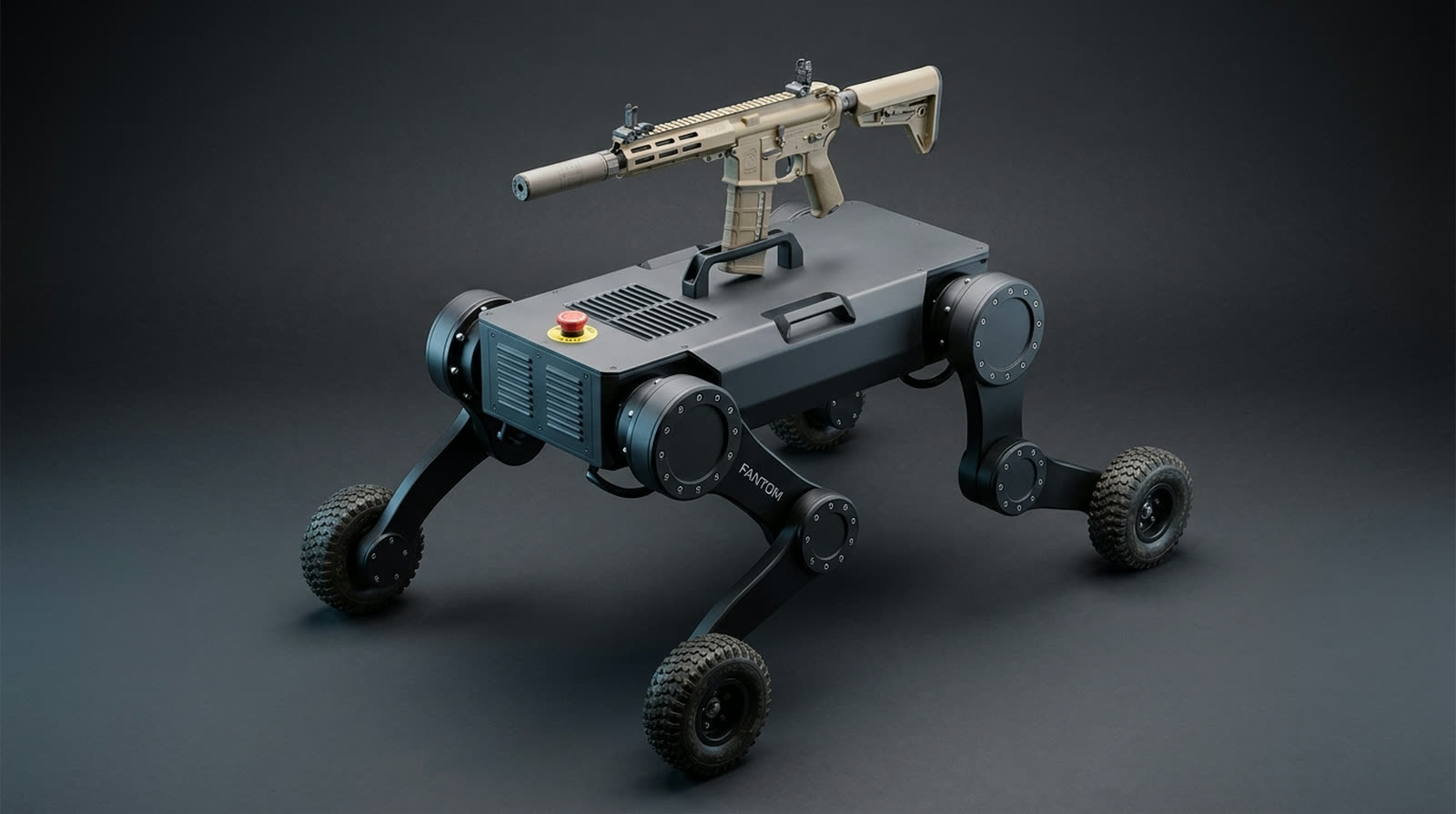
Concept renders · design lock
These are renders of the locked design, not photographs of hardware. No GRIM has been built. The weapon shown is a Q Honey Badger SBR; it has not been integrated with anything.
The sensor head
It has to see before it does anything else
A machine that works without a network has to resolve the scene itself, in the dark, in smoke, and while it is moving. No single sensor does that. The head carries four that fail in different directions, so that what defeats one is what another is good at.
Uncooled LWIR thermal
Long-wave infrared reads emitted heat, so it needs no light of any kind and it is not defeated by smoke, dust or foliage the way a camera is. It is also the only channel that works with the illuminators off — nothing is radiated, so there is nothing for anyone to detect. What it cannot do: see through glass, read a marking, or tell you which of two warm shapes is the one you were sent for. Thermal finds things. It does not identify them.
Intensified low light
The identification channel. Amplified visible and near-infrared keeps texture, contrast and text — the detail thermal throws away — down to starlight, and it degrades gracefully rather than cutting out. Under cloud with no moon it needs help, and the NIR illuminator that provides it is visible to anyone else wearing night vision. That is a deliberate, revocable trade, not a default.
8K day camera
Resolution is standoff. An 8K sensor behind a fixed lens lets the machine crop deep into its own frame instead of driving closer to see better, which keeps it outside the range where being seen matters. It is also what feeds the tracker — a detector is only as good as the pixels on the thing it is trying to hold.
On-board AI tracking
Detection, classification and multi-object track run on the node, on the machine, with no uplink and no round trip to anything. Tracks persist across a target passing behind cover and hand off between the thermal and the daylight channel as conditions change, so the machine keeps a continuous picture rather than re-acquiring from nothing every few seconds. A track is not a decision. Nothing in this chain can open the cradle; that requires the signed authorisation described below, and the two systems are deliberately kept apart.
Stabilisation, which is what makes the rest of it worth having
A quadruped's gait is the enemy of a long lens. At 8K, every footfall is visible in the frame, and a cropped view amplifies motion exactly as much as it amplifies detail — so an unstabilised 8K camera on a walking robot delivers less usable image than a stabilised 4K one. The head sits on a two-axis mechanical gimbal that absorbs pitch and roll, with electronic stabilisation on top of it for the residual. The same platform is what holds the weapon level while the body works underneath it.
Authorisation
Nothing fires without a signed decision
The cradle carries a mechanical interlock that is closed by default. It opens only when the node verifies a LEDGER-signed authorisation issued by an identified human against a key the node already holds — no network required, and no way to satisfy it with a replayed message.
The authorisation, the identity behind it, the target it applied to and the moment the interlock opened are all written into the same hash-chained record the rest of the system uses. The record is verifiable offline, afterwards, by someone who does not trust us. On an armed ground robot that is not a compliance feature — it is the precondition for anyone letting it out of the truck.
Status
Where this actually stands
GRIM is in design. No prototype has been built, no weapon has been integrated, nothing has been fired, and the figures on this page are targets rather than measurements. The films and renders exist to communicate intent.
The Honey Badger SBR is a product of Q, LLC. Naming it describes the hardware GRIM is designed around. It does not describe a relationship, and no agreement with Q exists.