
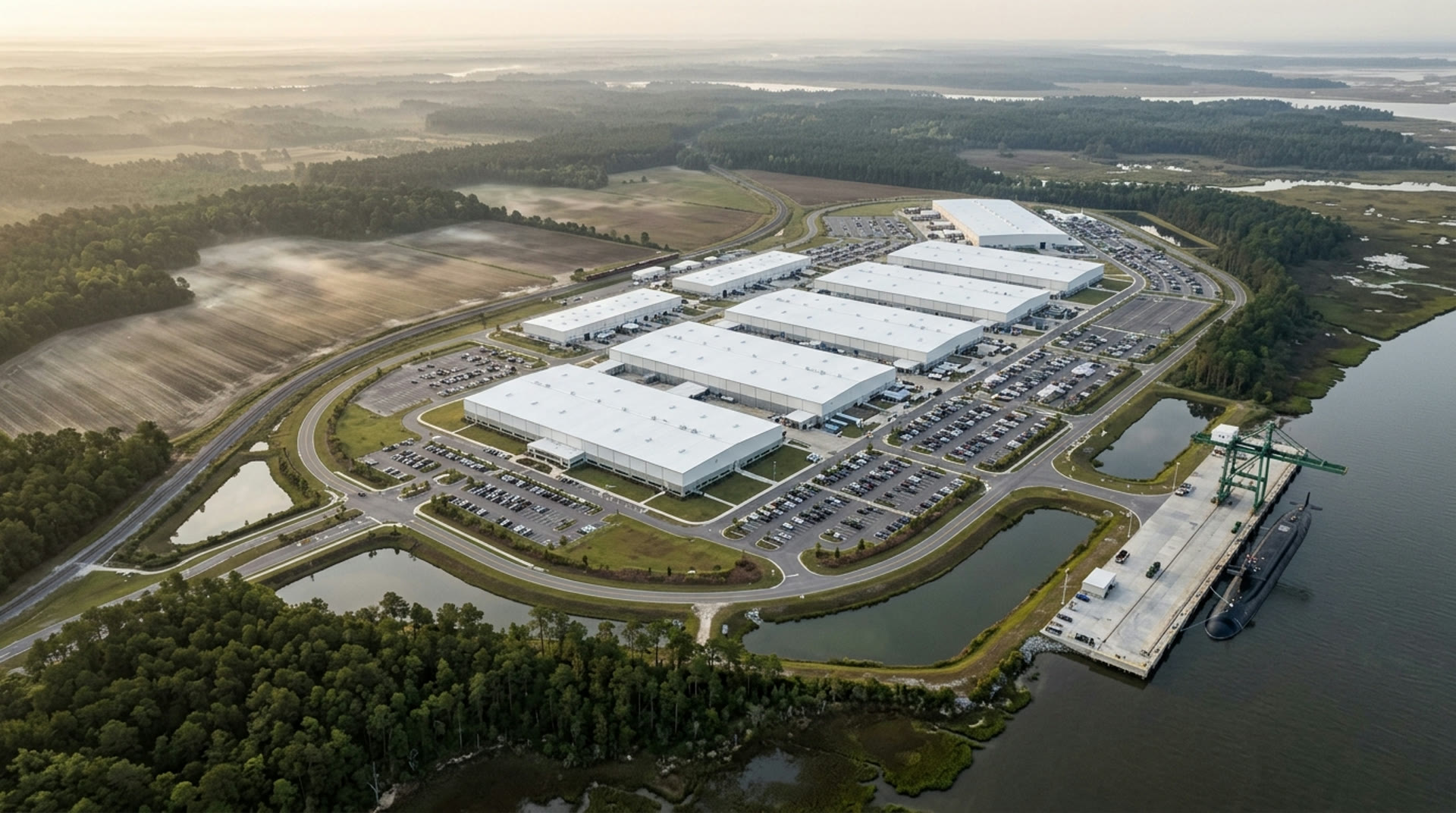
Air · Collaborative combat aircraft
Wraith
The wingman that does not get tired, scared, or old.
Mission
WRAITH is designed to be the first thing that enters a defended volume and the last thing anyone is willing to lose.
It flies as a delegated element of a crewed formation — nominally an F-35A — carrying air-to-air, electronic attack, ISR, decoy or fuel in the same bay, and it completes the mission with the datalink dead, the GPS constellation denied, and no uplink of any kind. Group 5 airframe, one F110-class afterburning turbofan on a thrust-vectoring nozzle, 615 nautical miles of combat radius with two AIM-120D internal, and it launches and recovers vertically from a road-towable launcher set down on unprepared ground.
It is not a pilot replacement. The captain in the F-35A remains the tactical authority and the legal authority. WRAITH is what he sends sixty miles in front of himself so that he does not have to go there.
Concept film
On station
Concept film · 0:45 · starts muted — unmute for sound
Nothing here is a record of a test. No WRAITH has been built or flown — the aircraft, the launcher, the formation and the engagement are all concept renders made to communicate the design intent.
Key figures
Specification
WRAITH parameters
Every figure below is a design target. The ones we do not yet own with test evidence are called out in the notes and in the open-risk list.
| Class | Group 5 CCA, Increment 2 |
|---|---|
| Configuration | Tail-sitter. Cranked lambda flying wing, four canted all-moving fins that double as the landing pedestal, dorsal flush intake, axisymmetric vectoring nozzle |
| Length | 26.4 ft (8.05 m) |
| Span, deployed | 21.0 ft (6.40 m) |
| Span, folded | 10.5 ft (3.20 m) — outer panels fold at the crank |
| Height, standing | 27.5 ft (8.38 m) — nose vertical, resting on the fin footpads |
| Pedestal footprint | 12.0 ft (3.66 m) across the four footpads |
| Wing area | 236 ft² (21.9 m²) |
| Aspect ratio | 1.87 |
| Leading-edge sweep | 47° inboard / 32° outboard of the crank |
| Tail | 4 all-moving fins in cruciform, canted 45°, 34 ft² each |
| Control surfaces | 4 elevons + 4 all-moving fins + 3-axis thrust vectoring |
| Landing gear | None. The aircraft stands on four fin-tip footpads with integral shock struts |
| Maximum vertical takeoff weight | 16,500 lb (7,484 kg) — structure- and fuel-limited, not thrust-limited |
|---|---|
| Operating empty weight | 7,600 lb (3,447 kg) |
| Internal fuel | 4,600 lb (2,087 kg) F-24 / JP-8 |
| Fuel fraction | 0.319 |
| Mission bay payload, max | 2,200 lb (998 kg) |
| Single station limit | 1,200 lb (544 kg) |
| Typical combat weight | 10,700 lb, 50% fuel and 2 × AAM |
| Wing loading at MTOW | 69.9 lb/ft² (341 kg/m²) |
| Powerplant | 1 × F110-GE-129-class afterburning turbofan with axisymmetric vectoring exhaust nozzle (AVEN), FADEC |
|---|---|
| Thrust, dry / augmented | 17,000 lbf / 29,000 lbf |
| Bypass ratio | 0.34 |
| Fan diameter / length | 28 in / 154 in |
| Engine dry weight | 3,980 lb |
| TSFC at cruise | 0.78 lb/lbf·h at 0.80 M / 36,000 ft |
| Thrust-to-weight, MTOW augmented | 1.76 — the vertical launch margin |
| Thrust-to-weight, MTOW dry | 1.03 — it leaves the ground on dry thrust; augmentation is margin, not a requirement |
| Thrust-to-weight, combat | 2.31 |
| Inlet | Dorsal flush, serpentine S-duct, no line of sight to the fan face |
| Exhaust | Axisymmetric vectoring nozzle, ±20° in three axes, serrated petals, cooled centrebody |
| Electrical | 2 × 90 kVA, 270 VDC main bus, 28 VDC essential |
| Combat radius | 615 nm with 2 × AIM-120D internal |
|---|---|
| Endurance | 3.6 h clean, unrefueled |
| Service ceiling | Above 50,000 ft |
| Max sustained | 0.95 M / 5.4 g at 15,000 ft |
| Dash, augmented | 1.15 M, 4 min — fuel-limited, not thrust-limited |
| Structural limit | −3.0 to +9.0 g — no pilot to break |
| Best cruise | 0.80 M / 36,000 ft |
| Loiter | 0.55 M / 39,000 ft, 940 lb/h average |
| Hover thrust margin at launch | 76% augmented at 16,500 lb, sea level, ISA +15°C |
| Vertical recovery accuracy | 0.6 m CEP onto the pedestal |
| Pad requirement | Transporter-erector-launcher on unprepared surface, CBR 6. No runway at any weight |
| Fuel spent on launch / recovery | 390 lb / 310 lb — 15% of internal fuel |
| Operational alpha limit | 24°, dorsal-intake constrained |
| Mission bay | 92 ft³ modular — AAM, EW, ISR, decoy or fuel |
|---|---|
| Bay envelope | 14.0 × 2.8 × 2.35 ft, two longitudinal stations |
| Module swap | 40 min on the flight line, 3 people, one 2-ton bay lift |
| Datalink | MADL-native two-way with F-35; Link 16; TTNT |
| MADL apertures | 6 conformal — spherical less a 9° aft cone |
| Silent mode | Intent-only optical crosslink, 1550 nm, 4.8 kbit/s, zero RF emission |
| Autonomy | REVENANT CORE — fights fully in EMCON with zero uplink |
| Mission compute | 2 × 128 TOPS INT8 sustained at 260 W, plus a 40 W survival node |
| Flight control | Quad-redundant fly-by-wire, 400 Hz, dissimilar backup lane |
| Navigation | Inertial, celestial, terrain-referenced and visual-inertial. GPS is an input, never a dependency. |
| Accountability | REVENANT LEDGER writer, tamper-responding key store, 2.1 GB per 3.6 h sortie |
| Unit cost target | $21M at rate |
|---|---|
| Production rate | 300 per year from FORGE-2 |
| First article | Q3 2028, FORGE-2 Savannah |
| First flight, target | Q1 2029 |
| Cost per flight hour | $4,900 — F-35A is publicly reported near $33,000 |
| Touch labor at rate | 3,900 h per airframe |
| Design service life | 6,000 flight hours / 4,000 cycles |
| Unique part count | ≈2,300 — a crewed fighter of this class is near 11,000 |
Crewed – uncrewed teaming
The captain and his wingman
A USAF captain in an F-35A. A WRAITH line abreast at a thousand feet of separation, high over a coastline at dawn. The WRAITH goes first into the threat ring. The captain never leaves the tanker track.
The captain does not fly the WRAITH. He has no stick for it, no throttle for it, and no second set of instruments. He delegates to it. From the panoramic cockpit display he selects a play, sets a geofence and a time box, and issues a scoped engagement authorization token. Three interactions. About four seconds of head-down time.
The token names what may be engaged, inside what volume, during what window, under what identification criteria. It is signed with the captain's cryptographic identity and written into REVENANT LEDGER on both aircraft before the element pushes. From that moment WRAITH can fight without asking — because it already asked, and the ledger proves when, by whom, and with what limits.
The number the program actually lives or dies on is crew workload: how much additional head-down time a two-ship WRAITH element costs its captain per engagement cycle. We have not measured it. Doing so requires a simulator campaign with current fighter aircrew that we have neither run nor commissioned, and it is the first thing we would want a Government partner to fund, because a number we generate about our own workload burden is worth very little.
Concept of operations
One sortie, start to finish
Launch from a dispersed site, push sixty miles ahead of the crewed aircraft, fight in EMCON under a pre-signed authority, recover to something that is not an airfield.
Five phases
-
Join and delegate
WRAITH launches from a dispersed site and joins the package on the tanker track. The captain selects a play, sets a geofence and a time box, and signs a scoped engagement authorization. Both aircraft write the token into LEDGER before the element pushes.
-
The push
WRAITH accelerates ahead and low, opening to 60 nm in front of the crewed aircraft, and enters the threat ring first. It is the sensor, the shooter and the target. The F-35A stays outside, receiving a MADL track picture from an aircraft sixty miles closer to the problem. The captain's aircraft has not radiated.
-
EMCON
The adversary IADS comes up. WRAITH transitions to silent mode: RF transmit is inhibited by a physical interlock in power distribution, not by software, and the inhibit state is LEDGER-signed. Coordination runs over the optical crosslink at 4.8 kbit/s — intent, not imagery. The pre-signed token is still valid, so the aircraft prosecutes inside its scope with no uplink at all.
-
Engage or expire
A track that meets the identification criteria, inside the geofence, inside the time box, is engaged, and the full decision chain is hash-chained at the edge. A token that expires while the link is down ends the engagement: WRAITH disengages and egresses.
-
Recover and debrief
Vertical recovery onto the pedestal, on the pad it launched from or any other patch of open ground within range — including a deck. The ledger export reaches the squadron debrief system in about six minutes and the sortie is reconstructed decision by decision.
Launch & recovery
A runway is a coordinate
A runway has a surveyed heading, a published length and a known maximum on ground. It is the easiest target set in the theater and it is the first one serviced.
Vertical launch
-
Choose the ground · 4 min
Fifty feet square, CBR 6 or better, level to within 3°. A hardstand, a highway shoulder, a parking apron, a clearing, the deck of an LSD. There is no cradle to level and no rail to align, because there is no rail. The four footpads are the launcher.
-
Erect · 5 min
The transporter-erector rotates the aircraft nose-up onto its own fin footpads and withdraws. From this point nothing but the aircraft is in the launch circle. Two people.
-
Unfold and pin · 6 min
Outer wing panels unfold at the crank and pin. Hand tools, no power, no alignment fixture. Mission bay loaded standing, from the transporter deck.
-
Start and authorize
Cold start on internal battery and APU. Engine to military power, FADEC confirms, nozzle sweeps its full ±20° envelope against the flight control model. LEDGER signs the launch authorization and the loaded ROE token. This is the last human decision until recovery.
-
Launch · 11 s
Dry power is enough to lift it; augmentation is there for margin. 76% thrust margin at 16,500 lb. Vertical rise under nozzle control alone — no rail, no boosters, no jettisoned hardware, nothing left on the ground and nothing expended. Transition to wingborne flight at 180 ft AGL and 120 KEAS, climbing.
-
Total · 19 min
Cold vehicle on a road to wingborne flight, with a trained two-person crew. The rail-and-booster alternative we costed against this one needs 44 minutes, four people, and leaves about $50,000 of boosters and expendable cradle frame on the ground at every launch.
| Mode | Requirement | Result |
|---|---|---|
| Vertical, land | Trailer footprint on CBR 6 or better, level to 3° | Decelerating transition at 900 ft, hover capture, 0.6 m CEP onto the pedestal |
| Vertical, shipboard | Any deck cleared for an MH-60, no arresting gear, no wire, no crane | Same profile, deck-motion compensated to Sea State 5 |
| Parafoil, emergency | Engine-out only. Any clear 120 × 120 m unimproved surface | 640 ft² canopy at 8,000 ft AGL / 160 KIAS, 21 ft/s, airbag to under 8 g |
Mission bay
The bay is the product
The airframe is a truck for it. 92 ft³, two longitudinal stations, 2,700 lb total and 1,500 lb per station.
| Module | Contents | Weight |
|---|---|---|
| AAM-2 | 2 × AIM-120D-3 on trapeze launchers — the 615 nm reference loadout | 780 lb |
| AAM-4S | 4 × AIM-9X Block II on rotary rails — counter-cruise and counter-UAS | 620 lb |
| SDB-6 | 6 × GBU-53/B StormBreaker — moving-target strike | 1,470 lb |
| ARM-2 | 2 × AGM-88G AARGM-ER — SEAD, both stations | 2,200 lb |
| EW-1 | REQUIEM-A pod carried internally — 14 kW draw, 9 kW rejection | 1,180 lb |
| ISR-1 | AESA SAR/GMTI side panels, EO/MWIR ball, wideband ESM | 1,340 lb |
| DECOY-6 | 6 × POLTERGEIST-150 in decoy fit — presents six more Group 5 signatures | 1,690 lb |
| TANK-1 | Conformal bay tank, 1,900 lb of fuel, +280 nm radius, single station | 1,900 lb |
Datalink & EMCON
Two ways to talk. One emits nothing.
A networked link when quiet is enough. An optical intent channel when the only acceptable emission is none — and a directional weather channel so that cloud changes the waveform rather than the plan.
MADL, natively
MADL is the F-35's directional, low-probability-of-intercept datalink. It is narrow-beam and it is quiet, which is why WRAITH is built around it instead of around Link 16.
- Six conformal apertures — two dorsal, two ventral, two lateral — giving spherical coverage less a 9° cone directly aft. Electronic steering; no gimbal, no bulge.
- 1.4 s link acquisition from a cued position, maintained to 90 nm in a line-abreast geometry. Sensor-to-display track correlation latency 180 ms.
- WRAITH appears as a native MADL participant, not as a gateway hanging off one. On the captain's tactical situation display it is a member of the flight.
There is no new box in his jet, no new switch, no new display and no OFP change beyond a Block 4 data load. That is the entire procurement argument, and it is worth stating flatly: the fastest way to field a CCA is to require nothing of the crewed fleet. Every program that has asked a fighter wing to install hardware has slipped years on the installation, not on the technology.
On provisioning: the MADL waveform and its cryptography are government-controlled, so the terminal is GFE and the interface is furnished, not bought. We designed for that rather than around it. MADL is an installed option, not a dependency: the teaming baseline is Link 16 plus the FANTOM directional channel below, both of which we control, and WRAITH is a useful flight member on either. Where MADL is furnished, it is the preferred path because it is the quietest. Where it is not, nothing about the mission changes except which waveform carries the track. A directional link also needs pointing knowledge; if the two aircraft lose each other, reacquisition takes up to 40 s of directed search across pre-agreed boxes. Directional links are quiet because they are narrow. You do not get one property without the other.
Silent mode
| Wavelength | 1550 nm, eye-safe band |
|---|---|
| Transmit power | 250 mW average |
| Apertures | 4 conformal, coarse pointing ±60°, MEMS fast-steering fine pointing |
| Range, clear air | 24 nm |
| Range, 3 km visibility | 9 nm |
| Effective data rate | 4.8 kbit/s |
| Acquisition, cold / warm | 6 s / 0.9 s |
| RF emission in silent mode | None — hardware interlock in power distribution |
| Weather channel | 94 GHz directional, 1.8° beam, frequency-hopped |
| Range in or behind cloud | 14 nm on the weather channel |
| Weather-channel data rate | 4.8 kbit/s — identical payload, no imagery |
| Optical → weather handover | Automatic, 400 ms, signed into REVENANT LEDGER |
Three states, chosen by the aircraft
- SILENT — optical only. RF transmit is held down by a physical interlock in power distribution, not by software. Zero RF emission, and the interlock state is signed.
- QUIET — the 94 GHz channel, entered only when weather closes the optical path. A 1.8° pencil beam between two known cooperating positions is hard to intercept for a geometric reason rather than a statistical one: an receiver off the beam axis sees nothing to detect, whatever its sensitivity. This is the same property that makes a directional datalink quiet in the first place.
- NETWORKED — Link 16, and MADL where it is furnished. Used when EMCON permits and the flight wants the wider picture.
QUIET is an emission and we will not pretend otherwise. It is a narrow, hopped, short-dwell one aimed at an aircraft whose position is already known to us, which is a materially different exposure from a broadcast — but it is not the zero of SILENT, and the mission planner is shown which state the flight is in.
Engineering rationale
Why it is built this way
Six decisions, and the price we agreed to pay for each one.
A bigger engine than the mission needs
An F110-class engine is heavier, thirstier and more expensive than a CCA of this size would otherwise carry. We take it because a tail-sitter has to beat its own weight at the instant of launch with nothing to fall back on, and an engine sized for the cruise leaves no margin for a hot day, a high field or a headwind. Oversizing the engine is how the vertical-launch problem is actually solved — it is the same answer Shield AI reached on X-BAT, which hangs an F-16-class engine on a far smaller airframe. The tradeoff: 3,980 lb of engine in a 16,500 lb aircraft, a thirstier cruise than a right-sized powerplant would give, more aft-quadrant infrared, and a meaningful share of unit cost — bought to make the launch case survivable rather than marginal.
The tail is the landing gear
Four all-moving fins canted 45° in cruciform, and those same four fins carry the aircraft on the ground. A tail-sitter has to stand on something; making the tail surfaces do it deletes a retractable gear, its bays, its doors and its hydraulics from the airframe entirely — weight you would otherwise haul to 40,000 ft and back on every sortie. The tradeoff: the fins are now sized by a landing case rather than an aerodynamic one, so they are thicker and heavier than aerodynamics alone would ask for, and a hard set-down is a flight-control-surface repair rather than a gear repair. A dorsal intake also starves at high alpha — 24° operational against the 32° the wing would give — accepted because a CCA in a close fight has already had a bad day.
A 40 W survival node
Two 128 TOPS mission computers do sensor fusion and multi-ship coordination. Behind them sits a 40 W single-board computer holding the complete REVENANT CORE world model, mission plan and ROE state, able to fly and fight the aircraft alone. Forty watts is the canon CORE envelope, and that is not a coincidence: the smallest node in the arsenal and the last surviving lane on the flagship run the same binary. The tradeoff: on the survival node the aircraft loses fusion fidelity and multi-ship coordination. It keeps flight, navigation, the ROE engine and the ledger writer.
Learned above, deterministic below
The learned components of the autonomy stack sit above a hard boundary and can only issue trajectory and effect requests. They cannot command a control surface. Below that boundary is quad-redundant fly-by-wire at 400 Hz with a dissimilar backup lane on different silicon and a different toolchain, DO-178C traceable. The tradeoff: the tactical layer sometimes asks for a maneuver the deterministic layer will not fly, and the deterministic layer wins. We lose performance in the corners. It is the only architecture anyone is going to certify this decade.
Fifteen percent of the fuel, spent on the ground
Vertical launch and vertical recovery spend 700 lb of internal fuel — 15% — before and after any of the mission happens. That is about 110 nm of combat radius on every sortie, including the ones flown from an airfield nobody ever threatened. The tradeoff was deliberate: a customer who never intends to disperse is buying 110 nm of nothing. A customer who does is buying the ability to generate sorties on day three of a Pacific fight, when the airfields are craters and a runway is the one thing nobody has.
Fuel as the heat sink
Peak thermal load with a REQUIEM-A pod in the bay is 21 kW, rejected to the fuel and then to a ram-air exchanger. That makes thermal margin a function of how much fuel is left, so the aircraft plans its electronic-attack duty cycle against its own fuel state. The tradeoff: below 900 lb remaining the pod caps at 45% duty. The alternative was a dedicated heat exchanger and 40 lb out of the bay budget.
Program candor
Open engineering risks
A spec sheet with no bad news in it is a brochure, and nobody buys airplanes from a brochure.
Seven of them
- Propulsion is the schedule, and vectoring made it worse. An F110-class afterburning turbofan is a mature, in-production engine, which helps more than a bespoke one would. A three-axis vectoring nozzle rated for full-authority use in hover, qualified for the thermal and acoustic environment of its own exhaust reflecting off the ground at four feet, is not something you buy from a catalogue. It is risk number one. Anyone who says otherwise has not tried to buy 300 engines a year, let alone 300 nozzles that have to work on the way down as well as the way up.
- MADL is furnished, not bought. The waveform and its cryptography are government-controlled, so we designed it as an installed option rather than a dependency — Link 16 and the FANTOM directional channel are the teaming baseline and both are ours. The residual risk is schedule on a GFE terminal, not capability.
- There is no accepted airworthiness standard for a learned flight-critical function. We have architected around its absence with a deterministic inner loop. That is a defensible architecture. It is not an approved one, because no approval process exists yet.
- Signature and rough-field operations are in tension and we have not resolved it. Every landing on a semi-prepared surface abrades the coating. Our budget is one touch-up per 40 unimproved-surface cycles. That number is not proven in the field, and if it turns out to be one per ten, the sustainment case changes materially.
- The launch structure penalty is permanent. 310 lb and 40 nm on every sortie, including the ones from a runway.
- The four-aircraft span of control is simulator data from a dome, not from a squadron at Nellis. It will move.
Systems that fly with it
All air systemsWRAITH program office
Bring us a threat picture
Signature data, MADL integration detail and classified performance are discussed in a cleared facility. Start here and we will arrange it.
Every figure on this page is a design target derived from first-principles analysis, not a measured result. WRAITH has not flown. No airframe, test article or flight-test data exists. Where a number here is later measured and comes out worse, we will publish the measured number. No export-controlled information is published on this site.